
The Workforce Journal by Shadow Office Solutions
The Workforce Journal
by Shadow Office Solutions
Blog Home Page / Global Exposure and Impact / AI Collaboration In Global Teams…
AI Collaboration in Global Teams: The Future of Work
- July 20, 2026
- The SOS Global Workforce Team
AI is reshaping how global teams work
Artificial intelligence is rapidly changing how organizations operate across borders. Global teams today rely on AI-powered tools to communicate faster, coordinate work more efficiently, and manage increasing operational complexity across different time zones and regions.
From automated summaries of meetings to real-time translation and workflow assistance, AI is becoming a core part of how modern teams collaborate. These tools reduce friction in communication and make it easier for distributed teams to stay aligned.
However, even as AI becomes more embedded in daily work, the foundations of effective global collaboration remain the same. Communication, trust, cultural understanding, and accountability continue to define how well teams perform. AI may change how work is executed, but it does not replace the human elements that make collaboration successful.
How AI is improving global teamwork
One of the most visible impacts of AI in global collaboration is improved efficiency. Teams that once relied heavily on manual coordination can now streamline many of these processes through AI-enabled tools.
Information can be summarized automatically, reducing the need for lengthy updates. Communication across different languages is becoming easier through real-time translation. Administrative tasks such as documentation, scheduling, and task tracking are also becoming more automated.
This creates a significant shift in how global teams operate. Instead of spending large portions of time managing coordination, teams can focus more on execution and decision-making.
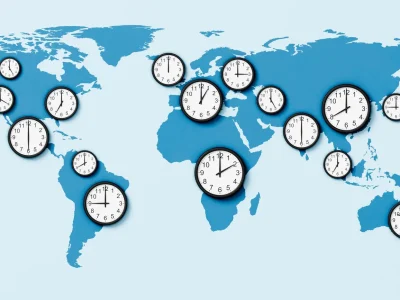
AI also helps reduce delays caused by time zone differences. Information can be processed, organized, and passed along more effectively, allowing work to continue even when teams are offline. In this way, AI supports the asynchronous nature of global work.
While these improvements increase efficiency, they are only one part of what makes global collaboration effective.
Why human judgment still matters
Despite the advantages AI brings, human judgment remains essential in global collaboration.
AI systems are effective at processing information, identifying patterns, and automating repetitive tasks. However, they do not fully understand context, nuance, or organizational priorities in the same way humans do.
In global teams, decisions often require balancing multiple factors such as client expectations, cultural differences, operational constraints, and long-term business goals. These decisions cannot always be made through automation alone.
Human judgment ensures that information provided by AI is interpreted correctly and applied appropriately. It also helps prevent over-reliance on automation in situations where context is critical.
In practice, AI works best when it supports decision-making rather than replacing it.
Cultural intelligence cannot be automated
One of the most important aspects of global collaboration is cultural intelligence. This refers to the ability to work effectively with people from different cultural and professional backgrounds.
While AI can assist with communication and translation, it cannot fully understand cultural nuance, communication styles, or workplace expectations across different regions. These factors often shape how messages are interpreted and how relationships are built within global teams.
Professionals who develop strong cultural intelligence are better equipped to navigate these differences. They understand that communication is not only about clarity, but also about context, tone, and timing.
In international environments, small misunderstandings can create larger operational issues if not managed properly. Cultural intelligence helps reduce this risk and strengthens collaboration across diverse teams.
This human capability remains essential even in highly automated environments.
Trust remains the foundation of global teams
While AI improves efficiency, trust remains the foundation of successful global collaboration.
In distributed teams, individuals often work independently across different time zones without constant oversight. This makes reliability and accountability critical to team performance.
AI can help track progress and organize information, but it cannot replace the trust built between people who consistently deliver on their commitments.
Strong global teams are built on predictability and follow-through. When team members trust that work will be completed as expected, collaboration becomes smoother and more efficient.
Over time, this trust reduces friction, improves communication, and strengthens long-term working relationships. It is one of the most important factors in sustaining global collaboration at scale.
Human-AI collaboration is becoming the new standard
The future of global work is not defined by AI replacing human collaboration, but by AI enhancing it.
In practice, this means AI handles repetitive, time-consuming, and administrative tasks, while humans focus on interpretation, decision-making, and relationship management.
This combination allows teams to operate more efficiently without losing the human judgment required for complex work. It also enables professionals to focus on higher-value activities such as problem-solving, strategic thinking, and cross-functional coordination.
Global collaboration in the age of AI is therefore not about choosing between technology and people. It is about integrating both effectively.
Organizations that succeed in this environment are those that understand how to balance automation with human capability.
The future of global work is hybrid
AI is transforming global collaboration by making communication faster, workflows more efficient, and information more accessible. However, the core drivers of successful teamwork remain unchanged.
Human judgment, cultural intelligence, trust, and accountability continue to define how effectively global teams operate. AI enhances these capabilities, but it does not replace them.
The future of global collaboration is therefore hybrid. Technology provides speed and structure, while people provide context, alignment, and direction.
Teams that learn to combine both will be better positioned to navigate the evolving demands of international work and build stronger, more effective collaboration across borders.


Tags: 10-min read, AI collaboration, global teams, future of work